Ten Tips for Tenacious Train Travelers
After moving to Sweden in 2018, I started traveling longer distances on a regular basis to visit friends and family both in my hometown, Perugia, and in Agrigento, where most of my relatives live. At the same time, I became more aware of the environmental impact of airplane travel. After a couple years of back-and-forth flights, a Stay grounded campaign allowed me to test out long-distance train travel, something I’d always felt drawn to, at a price compatible with my student finances. Many train rides followed that first three-day trip, most of which along the same approximate route from Sweden through Denmark, Germany, Austria (or Switzerland) to Italy, or vice versa. Here’s a selection:
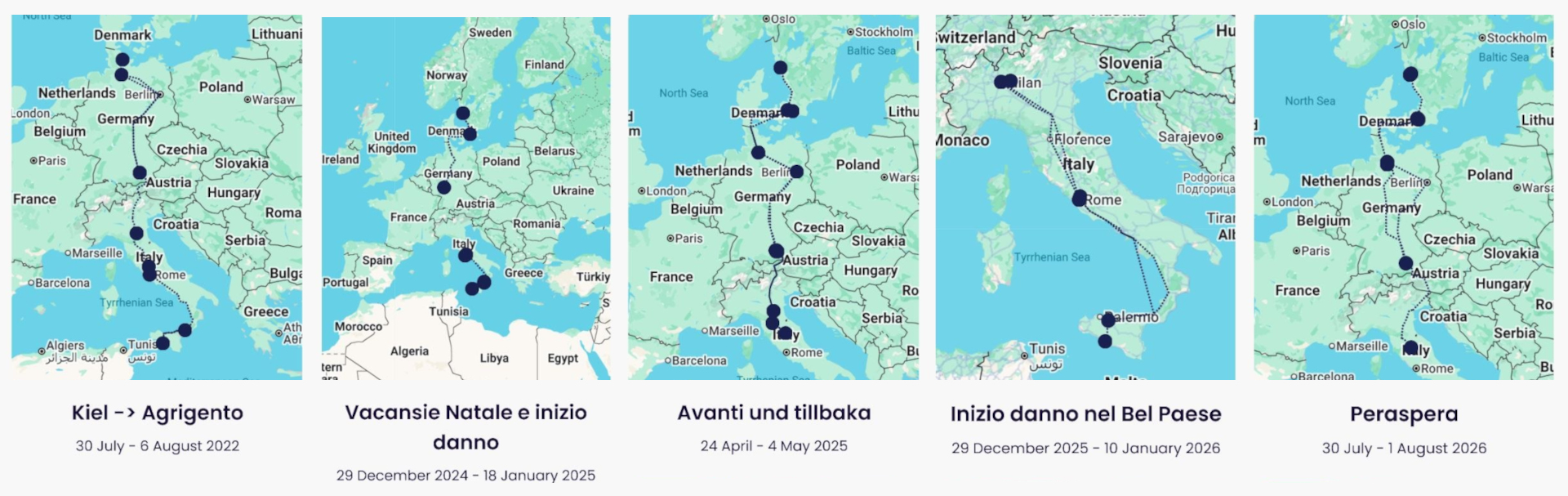
I’m not always able to travel by train, let alone the whole way, but I try to consider that option whenever I’m not too short on time. Not only is train travel more environmentally friendly than flying, it can also be more pleasant. Slower travel prompts reflection on the distance that, for better of worse, I’ve put between myself and some of my closest people, it works as a much needed buffer between a tough semester and a series of family gatherings and it gives me an excuse to visit new places along the way.
That said, train travel is terrible too. During my last trip back to Sweden, a series of cancellations, delays leading to missed connections and innumerable smaller inconveniences made the whole trip so frustrating that, if it wasn’t for a couple interesting conversations in Hamburg and a nice long walk Copenaghen, I’m not sure I’d be willing to ever do it again. Unfortunately, this is not an uncommon experience. As I explained in this thread, I feel less and less encouraged to choose rails over air: prices are crazy, bookings complicated, infrastructure unreliable.
If you’re new to cross-border train travel and still want to give it a try, here are a few tips to make your trip a little less exhausting and hopefully have some fun on the way. If you’re already a seasoned train traveler and want some advice about my usual route, you can jump directly to my bonus tips for fellow Scanditalians.
1. Travel light
When it comes to long-distance travel, my first and most obvious piece of advice is to try to pack as little as possible. For me, the best option is a single hiking backpack. In general, luggage you can comfortably walk around with allows you to make the most of waits between trains, even when they’re not long enough to make the luggage deposit worth it.
2. Don’t forget the essentials
Packing light is all good and well as long as you don’t underpack. What’s essential is highly subjective: many would say power banks and sleep masks are a must, but I usually carry neither.
Things I find useful while on a train include water, a renewable source of literature (aka an e-reading device), both headphones and earplugs (the baseline noise of some trains can be exhausting even in a quiet compartment and I have beef with ANC) and, in the likely event that the toilet lacks soap, hand sanitizer.
Once I get off the train, I need a smaller bag (ideally a foldable backpack, but a tote bag can also do the job) to put things I don’t want to leave at the station or wherever I spend the night, a raincoat or umbrella, basic cutlery for supermarket food and some hostel basics (padlock, flip-flops, towel).
3. Carefully choose your clothes
Besides these items, most of what I pack generally consists of clothing. During long-distance trips, it is important to me to feel comfortable in my body. In practice, that means layers (regardless of the season) and wide-leg/stretchy trousers, sometimes even skirts.
Another thing I always try to have (and often fail, because I was born female) is pockets. Losing my documents during an international trip is something I haven’t experienced yet and I’d like to keep it that way, so I prefer to have them on me.
4. Prepare to be offline
Despite more and more trains offering WLANs (sometimes remarkably good), internet access during travel should not be taken for granted. Even if you rely on your own mobile data, mountainous countries like Austria and Italy will give you a hard time. Plus, while EU roaming is a great thing, I’ve experienced way too many days-long connection failures due to mystery misconfigurations to fully trust my mobile.
As a consequence, when traveling across several countries, I prefer to assume I will be offline most of the time. For me, this implies some “digital packing”. In descending order of importance, I try to have offline access to:
- tickets, seats reservations etc.
- maps of the places I’m planning to stop at. For this purpose, I rely on CoMaps, a free and open source OpenStreetMap-based app
- music and podcasts
- e-books (alternatively, I pack a long physical book).
5. Consider a rail pass
You might think passes like the Interrail ones are expensive, and you’d be very right. Long-distance travel without a rail pass, however, tends to be a lot more expensive. Even in cases where booking trains individually seems cheaper, I strongly recommend considering a rail pass, especially for cross-border journeys. In the event of a significant delay, which you should expect, it’s usually easy (at least in some countries) to get a reimbursement for that specific train/operator, but nobody will pay you back for any missed connections if the trip involves multiple operators. Traveling with a pass gives you the peace of mind that, if you miss a train, you can always get the next one without additional costs (modulo seat reservations).
6. Minimize seat reservations
Unfortunately, traveling with a rail pass is not as flexible as it looks. A lot of European operators force seat reservations, which come with additional fees. In my personal experience, these are between 3 and 15€ depending on how you book (yes, different sites have wildly different prices) and where you go. While this might not sound like a lot, reservation costs quickly add up. For that reason, my advice is to avoid reservations as much as possible, even if that means taking a regional train instead of a high-speed train. If this is not possible, it’s up to you to decide whether to prebook your train, risking having to pay the fee twice in case of a missed connection, or wait until the very last minute, risking not to find a seat. I usually opt for the latter, and in more than one occasion I managed to convince the train conductor to let me in anyway.
There are two important exceptions to this rule: night trains and the first leg of you trip. If you want to sleep (horizontally) on a night train, you should definitely book well in advance. If you have the chance to start a long trip with a high-speed train and the route is popular, a reservation might be worth considering too.
7. Keep track of places to (re)visit
On top of expecting setbacks, you should try to embrace them. Missed your connection in Hamburg? Well, there’s a museum to visit right next to the train station! Stranded in Bologna? Good to know there’s a good hostel to spend the night!
In some cases, you’ll have to improvise, but it’s good to keep a set of potential stops in mind when planning for a long journey. When you travel the same route over and over like me, it can also be a good idea to take note of places to revisit (or to avoid). In my maps app, I have pinned a few strategically located places I want to visit (both towns I haven’t been to and specific attractions I missed on previous trips). Recently, I’ve also started using it to note down the best and worst overnight stays.
8. Be aware that not all schedules are created equal
You would think that the schedule on your phone is the same as the departures board at the train station, in which case you’d be right most of the time. Actually, only some of the time depending on what schedule you’re looking at on your phone.
Based on my personal experience, a good rule of thumb is that the Interrail app is less reliable than the local railway website/app, which is in turn less reliable than the station’s departure board (which is still less reliable than the spoken announcements, but whether the announcements are comprehensible depends on language skills, hearing and acoustics).
In particular, remember that the Interrail schedule is not updated in real time, or at least that the schedule you see when you are offline is not necessarily the same schedule you saw when you were online last time. It might very well be older.
9. Talk to people
My second to last piece of advice is to try not to be afraid of talking to people, and I mean it in two different ways:
- definitely talk to the ticket inspector if you’re breaking a rule for lack of a better option (e.g. if you’ve boarded the train without a mandatory seat reservation because the site was down, the train was fully booked or you really didn’t make it in time). If you speak for yourself, chances are you won’t be fined. Similarly, ask for help if you get stuck at a train station. The fact that (an unreliable version of) the schedule is in your pocket doesn’t make info points any less useful. People working there may have crucial bits of last-minute information, plus they’re sometimes quite empathetic
- if you’re having a frustrating ride, try to exchange a couple words with your neighbor. If you end up staying at a hostel, see if you can take it as a chance to socialize. Sometimes these random exchanges are what makes travel interesting, or at least bearable.
10. Join the ERPU!
During my last and most cursed trip, I learned about the European Rail Passengers Union, an organization that advocates for cross-border rail passengers rights. At the moment, the focus is on the EU’s rights and ticketing proposal which they explain in detail and propose amendments to. While even the best EU policy won’t eliminate all of the struggles of train travel mentioned in this blog post, this initiative certainly goes in the right direction and I think it is worth supporting.
Bonus tips for fellow Scanditalians
If you’re planning to cross Europe north-to-south like I routinely do, here’s some extra advice for you:
- the Danes really like passport checks. Remember that free borders Eutopia? Between Sweden and Denmark, as well as between Denmark and Germany, it is indeed still a utopia. If you have any potential visa issues, this is definitely something to consider
- the central station’s luggage deposit in Copenaghen has a fixed daily price. Last time I was there, it was 70 Danish crowns for a smaller cabinet, 95 for a larger one
- there is absolutely no need to book seats on DB trains. Despite what Germans say about their own railways, Germany is one of the best countries to interrail through. That’s because DB acknowledges that it’s basically impossible for all seats to be occupied for the entire duration of the trip and lets you board any train without a seat reservation. If seats are bookable at all, you’ll find an LCD on top of each showing you whether it is reserved and, if so, from which station to which station it will be occupied. Worst case, you’ll have to move around a bit
- some trains between Austria and Italy require an additional fee, but you can pay it right on the train. I’d also say that if you’re not asked about it, you don’t need to remind anyone, even if that contradicts part of point 9. Traveling by train is already expensive enough
- night trains to Sicily have some quirks. The Termini-Termini (Roma Termini to Termini Imerese) Intercity Notte is a complicated train. It divides up and, in Villa S. Giovanni, it boards a ferry to Messina. To avoid any surprises when you wake up, I strongly recommend triple checking that you’re sitting in the correct compartment for your destination. As for reliability, it always seems to be catastrophically delayed halfway through the trip, but usually manages to catch up in the end. In any case, I wouldn’t waste too much time staring at the train status on the Trenitalia app: once it reaches Sicily, the train invariably changes name and figuring out the new one is a nontrivial task to say the least
- if you’re travelling to Sicily by day, it is much faster to get off the train in Villa S. Giovanni and board the ferry to Messina on foot. As far as I remember, this ferry is not included in Interrail passes, but it isn’t very expensive
- refilling your water bottle is done differently in different countries. In Sweden, it is perfectly acceptable to enter a cafe and ask for some tap water. In Italy, this is less customary (you can still ask, but keep in mind that drinking water is not as easy to come by in the first place, especially in the south), but water fountains are much more common. OpenStreetMap can help you find them.